A Well-Fed Kenya: Food and Photojournalism
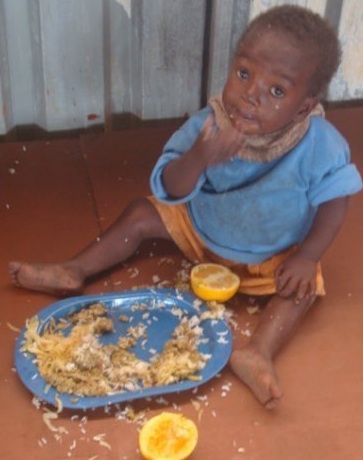 Some stories enter my bones and don’t leave. The story of Nairobi Food Not Bombs is in my marrow and vibrating, refusing to be ignored.
As C.T.’s partner, I’m a witness to the daily news feed of Food Not Bombs arrests and court cases, mostly here in the U.S. In addition, he gets a steady stream of calls all day, mostly people asking advice on consensus and also starting a Food Not Bombs.
One such FNB startup was germinated from C.T.’s trip to Nairobi, Kenya, in 2007. He was there to teach consensus at the IndyMedia Convergence, in advance of the World Social Forum.
IndyMedia is an amazing case study in do-it-yourself journalism, personal and collective empowerment. IMC “converges” at the site of each World Social Forum, a week or so before the WSF begins, to teach grassroots journalism to non-corporate press from all over the world.

IndyMedia Convergence, Dakar, Senegal, 2011
The convergences are temporary Intentional Communities that operate by consensus. Workshops teach would be journalists from Africa, South and Central America, Europe and the U.S. in street-level skills like building radios and transmitters out of materials available where they live.
At the Nairobi convergence, C.T. taught consensus and also pulled a hidden skill out of his hat—He taught IMC participants how to build a silkscreen press! This knowledge came from his early days of battling
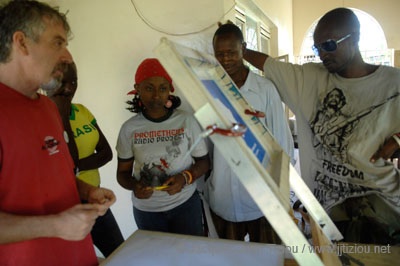
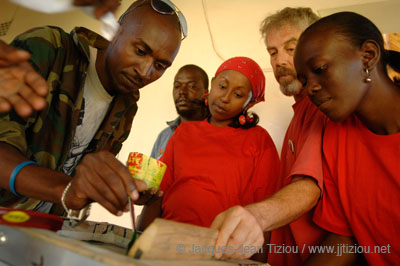
C.T. teaches IMC journalists how to build and use a 3-color silkscreen press to generate fliers, books, posters, t-shirts, etc.
Seabrook Nuclear Power Plant, starting the first FNB collective, the start of ACTUP, etc.
The convergences are meetings of very different cultures. In Nairobi, C.T. was the “old guy.” While the Northerners (Europeans and Americans) gave him little rank and dismissed his efforts to teach, Africans sought him out and revered him as the elder in the group.
One such new friend erased C.T.’s name from a community chore chart and wrote his own in its place. “In my culture, elders do not do the dishes,” He said.
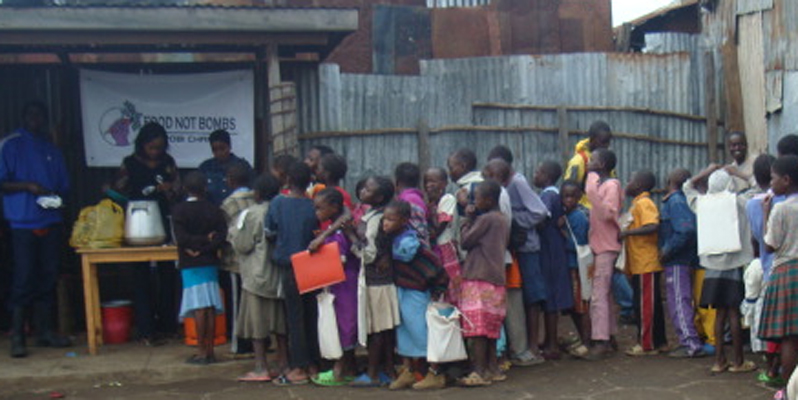 Douglas Rori, a convergence participant who was local to Nairobi, was so taken by C.T.’s stories of Food Not Bombs that he started a Nairobi chapter.
A Totally Different Ballgame
But unlike the twentysomethings who start chapters in their Midwestern college towns or face up against the police in Tampa, Florida, Doug and his Nairobi compatriots couldn’t just show up in the town square or public park with a table and pots of yummy vegan soup.
That’s a recipe for a food riot.
The hunger issue is not a minority issue there. Public feedings such as FNB is famous for the world over would put Doug and other volunteers at physical risk. Plus, with their food stolen, they would not complete their goal of serving the large population of street kids, mostly orphaned in the AIDS epidemic.
Sewing in the IndyMedia Thread
This is where the story gets dramatic in order to prevent drama.

Learning photojournalism
Doug and other young Kenyan activists had the direct experience of how empowering it is to learn tools for telling personal and local stories; to be an alternative to the corporate press party line.
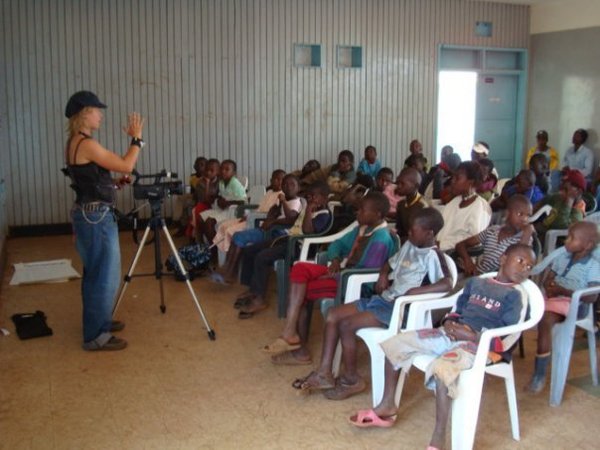
And they had learned filmmaking, photography and journalism in that way. Doug decided to disguise their feedings by offering journalism workshops to the homeless kids.
They chose enclosed courtyards and indoor spaces and spread the word about their workshops. As you can see by the photos, people of all ages came to learn.
And meals were included!

Doug leading a workshop
To keep this innovative project going, Doug has formed an NGO, A Well-Fed Kenya, in partnership with A Well-Fed World. This status enables him to operate and seeking funding on an ongoing basis.
Even with NGO status, life is still touch and go for Doug. An IndyMedia colleague was gunned down a few months ago in one of the ghettos, probably an assassination. Doug himself struggles to keep a roof over his own head as he does this important work.
To fund his project and stability for the coming months, we have collaborated with him on an Indiegogo campaign. Please
CLICK HERE TO VISIT OUR CAMPAIGN PAGE,
make whatever contribution you can, and tell your friends Doug’s amazing story! Let’s pull together to keep this project going in the ghettos of Nairobi!
 We are starting out with some popular perks from our previous Indiegogo campaign, Food Not Bombs t-shirts and copies of C.T.’s books, On Conflict and Consensus and Consensus for Cities.
Doug is also making contact with some fair trade crafts cooperatives and exporters in Nairobi who may be willing to donate some of their jewelry and other crafts as perks for the campaign. So watch for additional perks!!!
 How can you get involved? Certainly, donating whatever you can is a huge start. Are you willing to join our campaign team and use Indiegogo share tools and social media to spread the word? Reaching out to people who don’t already know me, C.T. or Doug Rori is a great help.
What ideas do you have for getting the word out about this impactful project?
If you’re in the D.C. region, C.T. and I can schedule a House Party with you. We can supply a slide show, talk about the project with friends you invite, and seek donations. Contact us at fiopa@consensus.net today to make arrangements!
Our main goals for now are to share this amazing story of risk, caring and daring and to get folks to visit our campaign page and donate. We must keep this work going!
When visiting the campaign site, do take the time to go through the photo gallery picture by picture. The interest of the kids in learning from Doug and his friends is amazing. You will understand from the numbers of people who attend that his offering is relevant and is making a difference.
What can you give today?


Join our Hippie Chick Diaries fanpage on facebook!
Subscribe to this blog's RSS feed
Owning Our Stories: Building a Silkscreen Press in Nairobi
 It’s always a good day when I wake up to surprise jpegs in my inbox. If you’ve kept up with Hippie Chick Diaries for any time, you know that photos are often the seeds of posts.
Here we see my partner, C.T. Butler, in Nairobi, Kenya, teaching a workshop in how to build a three color silkscreen press.
It was 2007 and C.T. was attending the IndyMedia Convergence in advance of the World Social Forum in Nairobi. When there’s a World Social Forum, 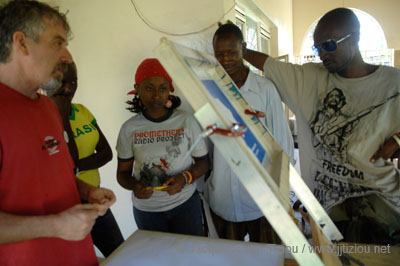 IndyMedia holds a convergence at the location, for a week or so before the event, teaching independent journalists and activists from around the world how to get their stories out using materials at hand. For example, workshops include building radios and transmitters from locally available materials.
When their training is done, the journalists and activists are a well-bonded collective that then covers the World Social Forum.
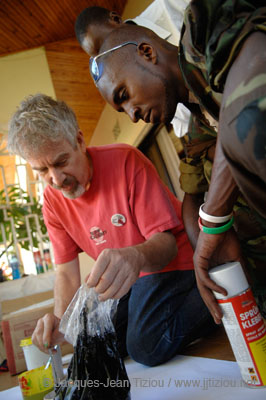
C.T. and Doug
C.T. attended the Nairobi convergence at the invitation of IndyMedia (aka IMC). C.T. is cofounder of the movement Food Not Bombs. The two groups have many cross connections and cross pollinations. Like Food Not Bombs before it, IndyMedia is leaderless, focused on local groups, horizontal in structure, consensus-based, etc.
C.T.’s primary focus was teaching consensus to convergence participants, but his experience in the early days of both FNB and IMC taught him do-it-yourself skills like building a silkscreen press by hand. C.T. often built and used makeshift silkscreen presses in his activism on the east and west coasts of the US.
Activists used the silkscreens to make three color posters, fliers and t-shirts at low cost. Many people are walking around today in Food Not Bombs t-shirts screened by C.T.
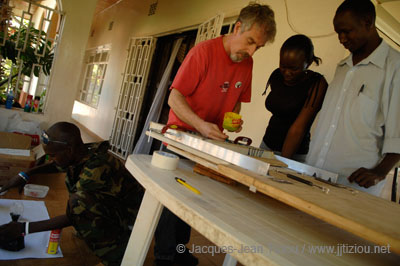 But when C.T. tried to teach this DIY information-sharing tool with activists in Kenya, it was not so easy. Several cultural differences got in the way. First, The most of the African students had not ever held tools like screwdrivers and hammers. Not a universal part of the upbringing.
Second, there was no Home Depot to go and buy all the supplies and tools. Instead, Nairobi marketplaces had little shops that specialized. There might be an entire shop for screws. That’s all they would have. New, used, mystery screws, chocolate screws, Martian screws…they would have it all, but C.T. found himself going to a dozen different shops,  sometimes more than once. Lumber was an odyssey unto itself.
I came into these photos because our friend Doug Rori, in the camouflage jacket, is working with us on a new Indiegogo campaign to fund his work with A Well-Fed Kenya. (More on A Well-Fed Kenya in upcoming posts!) I asked him for pictures of the two of them together, to help tell the story of our collaboration.
I love that what he found were pictures of the silkscreen workshop. C.T. had told me the story several times and it captures my imagination to realize the ways we can take our power back. If we can mass produce our own newspapers, t-shirts, posters, etc., with found materials, then we control our message, we own our stories. This is the profound power of the silkscreen press workshop, like all the others during the IndyMedia Convergence.
[Activists in Mexico made entire copies of C.T.'s book, Food Not Bombs: How to Feed the Hungry and Build Community, in Spanish, on a silkscreen press. His copy is one of his treasured possessions!]
The students and C.T. made a press that day. And today Doug and I will launch our Indiegogo campaign to get the message out about a really amazing, holistic project that feeds many people and teaches them the skills of getting their own messages out every day. Stay tuned!
Heathcote Community Hosts Baltimore Racial Justice Action
Forwarding press release—WT:
Achieving Racial Equity in Our Communities and Beyond
Have you heard the phrase “white privilege?” Why are people talking about it? What is it? Who has it? What can we do with it? How can we be sure that what we are trying to achieve will not maintain unequal patterns and disparities in outcomes? If you are interested in these topics but are afraid to explore them for fear of being misunderstood or “called out;” if you are struggling with your own baggage around these issues or want to increase your understanding of and effectiveness in diverse environments; if you’re working on grass-roots organizing, working with community organizations, just your own family, or want to organize your own anti-racism community, come join us. In this workshop we will view the video, Mirrors of Privilege: Making Whiteness Visible and engage in a facilitated, safe but frank discussion of contemporary race-related issues.
No matter where you are in your journey, BRJA provides a supportive, non-judgmental community of trainers/facilitators.
All are welcome to join us.
Suggested donation: $5 – $20.
Friday, May 13th
6:00 – 9:00 pm
HEATHCOTE COMMUNITY
21300 Heathcote Road
Freeland, MD 21053
Please join our Hippie Chick Diaries fan page on Facebook!
FREDERICK, MARYLAND POW-WOW SCHEDULED FOR May 2011: Frederick Food Bank TO Benefit From Pow-Wow
Forwarding a press release.—WT:
Hollister, NC- Pow-Wow, an American Indian owned and operated company, will sponsor the Frederick, Maryland American Indian Pow-Wow and Show at the E-Eventplex at the Frederick Fairgrounds (797 E. Patrick Street Frederick, MD 21705) on May 21-22, 2011. The Pow-Wow is an opportunity for the public to interact with American Indian dancers, singers, drummers, artists and craftspersons. This event is an attempt by Pow-Wow to educate the public about American Indians, past and present, through the arts.
The pow-wow is an opportunity for the public to interact with over 100 American Indian dancers in regalia (outfits), singers, drummers, artists, and crafts persons. Over $8,000 will be offered in dance and drum prizes, which will attract more than 100 dancers in full regalia from throughout the United States and Canada. At least Five (5) drums are expected.
On Saturday, gates will open at 11:00AM, and the event will kick off with a parade of nations (grand entry) at 12:00 noon. Over 50 Tribes will be represented at this year’s event, and they include: Haliwa-Saponi, Piscataway, Chickahominy, Rappahannock, Cherokee, Sioux, Iroquois, Lumbee, Hopi, Mattaponi, Nansemond, Choctaw, Navajo, and so many other Tribes and nations.
Hoop Dancer Pete Four Winds (Mohawk) and Juan Salinas of the Aztec Dancers will perform both days.
Fun activities for children include: Storytelling by Rose Powhatan, pony rides, face painting, tipi visit, bow ‘n’arrow shooting and a make it/take it table.
The public will be able to purchase some of the finest Native American crafts available. Items for sale include turquoise jewelry, moccasins, beadwork, rugs, books, paintings and dreamcatchers to name a few. Buffalo stew, fried bread, Indian corn soup and buffalo burgers are just a few of the Native American food items that will be on sale at the event.
Admission to the Pow-Wow is as follows: Friday-$10 for everyone Saturday –Sunday: Ages 3-12: $6:00 Ages 13-up: $10.00. The Frederick Food Bank will benefit from the Frederick Pow-Wow. A donation of a non-perishable food item at the gate on Saturday or Sunday will allow a person/family to receive $1 off each ticket purchased. This offer is not good with any other offer. Please call Ms. Sarah McAleavy, Coordinator of Food and Nutrition at Frederick Food Bank for more info concerning our food drive. Her number is (301) 600-6263.
For more information regarding the pow-wow, please call the show promoter at (252) 586-7913 or (252) 532-0821 or send e-mail to: powwow@vance.net This is not a web-site.
OUR WEB-SITE IS: http://www.myspace.com/powwow4life
TELEVISION AND PHOTO OPPORTUNITES
FREDERICK, MARYLAND AMERICAN INDIAN POW-WOW SCHEDULE-UPDATED
May 21, 2011
11:00AM-Gates Open/Vendor Sales
12 Noon-Grand Entry/Parade of Native American Dancers
1:00PM-Moccasin Blowout-Exhibition
1:00: Storyteller-Rose Powhatan
1:15: Hoop Dancer-Pete Four Winds
1:30-3:00PM-Native American Dancers-Exhibitions-1st round of contests
3:00-3:15: Storyteller-Rose Powhatan
3:15-3:30: Hoop Dancer-Pete Four Winds
3:30PM-4:00PM-Juan Salinas, Aztec Dancer
4:00PM-Moccasin Blowout Competition-1st Round
4:30PM-6:30PM-Native American Dancers/Contests/Exhibitions/Specials/honors-2nd round of contests
7:00PM-Gates Close
May 22, 2011
11:00AM-Gates Open/Vendor Sales
12 Noon-1:30PM-Grand Entry/Parade of Native American Dancers/Exhibitions
1:30PM-1:45PM-Storytelling: Rose Powhatan
1:45PM-2:00PM: Hoop Dancer-Pete Four Winds
2:00-3:30PM-Native American Dancers-Exhibitions-2nd round of contests
3:30PM-Juan Salinas-Aztec Dancer
3:50PM-Moccasin Blowout Competition-2nd Round
4:00PM-6:00PM-Native American Dancers/Contests/Exhibitions/Specials/honors-2nd round of contests
6:00PM-Announcementt of winners
6:00PM-Gates Close
Please join our Hippie Chick Diaries fan page on Facebook!
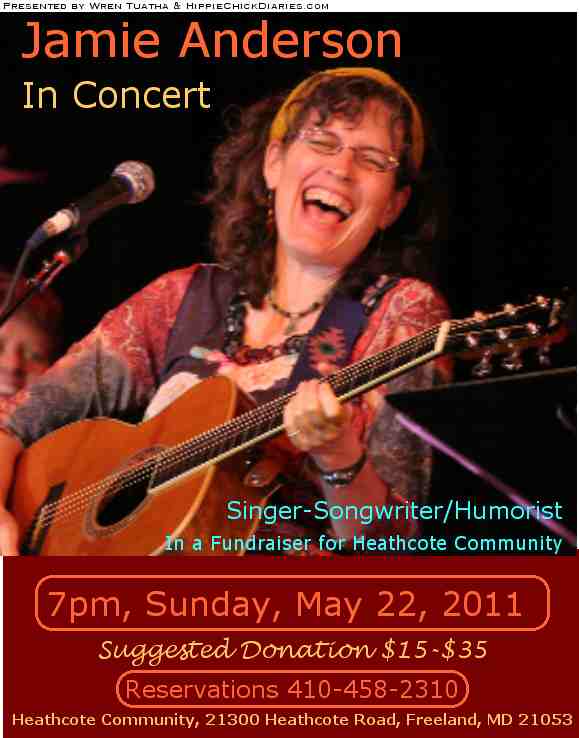
May 22 Fundraiser for Heathcote Land, Permaculture; Features Jamie Anderson
 In my world, Permaculture education and comedic Lesbian folk music are a luscious combination, like chocolate and peanut butter. Remember those Reese’s commercials in which one person is walking down the street eating a chocolate bar and someone is walking towards them eating from a jar of peanut butter and they’re both so self absorbed that they don’t see the other, collide, and their food gets combined, thus delivering them to a higher level of Nirvana? Well, Jamie Anderson probably has a song about that.
I’ve been keeping it in the back of my mind that I’d like to get Jamie to Heathcote Community for our House Concert Series, and now that chocolaty muse has collided with Heathcote’s exciting new opportunity: An adjoining piece of land which we’ve always held dear is for sale, giving us a chance to greatly expand our organic farming and Permaculture education programs. Oooh! Peanut butter!
The Anacker Land
 Heathcote Community was founded in 1965 when Bill and Margaret Anacker, members of the School of Living, sold a 37 acre parcel of their land to SoL as a headquarters for the magazine Green Revolution and as a homesteading demonstration site. As a 1960’s & 70’s style hippie commune sprouted and grew on the land, Bill and Margaret were very involved, mentoring young folks in homesteading and sustainability skills. The community overlapped onto other parts of the Anackers’ land and the community evolved into a wimmin’s land through the 80’s and eventually a mixed queer & straight community of settled members. Over time, Heathcote acquired parcels we call the Farmhouse land and Cabin land, or, Back 70, both of which had previously been the Anackers’, and which helped us expand our membership and unify our little valley.
 Now with Margaret passed on and Bill needing eldercare, the Anacker family is selling the 24 acre parcel on which Bill and Margaret homesteaded for so long. This land would give Heathcote our first substantial ridge top acreage, suitable for gardening/farming we haven’t been able to do down in our narrow valley and flood plain. This would allow us to expand our Permaculture education, internships and community membership, and provide crops for donation, Community Supported Agriculture (CSA) and/or market gardening, as well as allowing Heathcote to increase our food self-sufficiency.
We have some substantial pledges from large donors, starting us on our way. We’re partnering with Fusion of Baltimore as our fiscal sponsors. We’ve formed a fundraising committee and seek broad community support for bringing the Anacker land into the community.
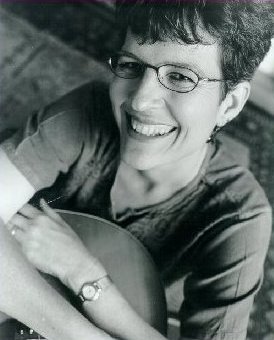 Jamie Anderson
Award winning singer-songwriter/parking lot attendant Anderson plays tunes that go from sexy to silly, witty to whimsical. She first hit my radar when Louisville DJ and Yer Girlfriend vocalist Laura Shine played her music at a time when we were first launching our Fairness Campaign there. She’s been on my playlist ever since!
She draws from many influences. As her website explains: She’s country without the big hair, bluegrass without the whiny tenor, blues without selling her soul and rock without the dirty t-shirt.
Besides songs that range from laugh out loud to tugging on your heartstrings, Jamie is adept at improving witty, thoughtful intros and stories. Her shows are great entertainment on many levels!
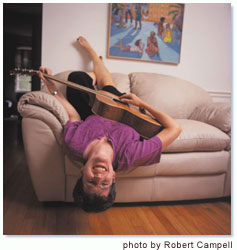 More nibblets from her site:
When Jamie isn’t touring, she’s taught songwriting, guitar and other classes at Duke University, arts centers, privately and at festivals all over the country. She has a chapter in Songwriting and the Guitar, a book that also includes Paul Simon, The Indigo Girls, Joni Mitchell and others. Jamie is a freelance writer whose articles and CD reviews have appeared in Acoustic Guitar, Curve, SingOut! and more.
Anderson’s awards include Finalist (USA Songwriting Competition, “Your Mama Scares Me,” 2008), the Jane Schliessman Award for Outstanding Contributions to Women’s Music (Women in the Arts, 2006), Best Folk Album (The Independent, A Promise of Light, 2005), Honorable Mention (Great American Song Contest, “Beautiful,” 2005), and others that only her mama cares about.
Save the date: May 22, 7pm. And stay tuned to Hippie Chick Diaries for more articles with links to Jamie’s songs and details about our silent auction and plant sales!
Please join our Hippie Chick Diaries fan page on Facebook!
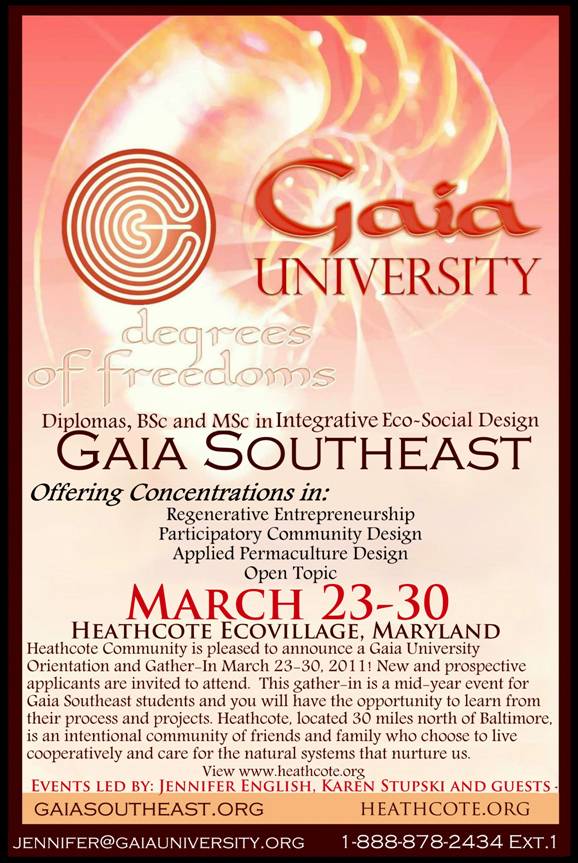
If You Missed Saturday’s Gaia U Open House, Here’s Your Second Chance!
Come to our Gaia University Open House!
March 5, 2011, 7:30 – 9:00 PM at Heathcote Community
Come learn about Gaia University, an institution for higher learning with a unique approach. The students (called associates) are able to earn accredited Bachelors & Masters degrees and Graduate Diplomas whilst being actively engaged in self and planetary transformation and ecosocial regeneration. The Open House will provide an overview of Gaia University’s action learning methodology and our programs in Integrative EcoSocial Design with concentrations in Applied Permaculture Design, Regenerative Entrepreneurship, Participatory Community Design, and Open Topic.
Heathcote is partnering with Gaia Southeast to host a Gaia Gather-In March 23-30, 2011. Prospective applicants may attend the whole gathering or audit individual days. Find out more at the Open House!!
Please RSVP by Mar. 4 by calling 410-357-9523 or email education@heathcote.org.
From Wren: I attended last Saturday’s Gaia U Open House. I continue to be amazed at the scope and effectiveness of Gaia U. It brings our alternative values into practice, while educating alternative-minded students in hands-on, exploratory, real world ways. It’s a great alternative to the conventional classroom! I hope you can make this Open House or connect with Gaia U through its website or other means! —WT
Gaia University Open House: Feb. 19, 2011, 1-3 PM at Heathcote Community
Come to our Gaia University’s Open House!
Feb. 19, 2011, 1-3 PM at Heathcote Community
Learn about Gaia University, an institution for higher learning with a unique approach. The students (called associates) are able to earn accredited Bachelors & Masters degrees and Graduate Diplomas whilst being actively engaged in self and planetary transformation and ecosocial regeneration. The Open House will provide an overview of Gaia University’s action learning methodology and our programs in Integrative EcoSocial Design and Open Topic. Heathcote is partnering with Gaia Southeast to host a Gaia Gather-In March 23-30, 2011.
Please RSVP by Feb. 16 by calling 410-357-9523
or email education@heathcote.org
Note from Wren: Karen Stupski and I attended some of the first organizational gatherings of Gaia University at The Farm in Tennessee several years ago. I was electrified at the bold notion that our alternative culture could create higher education models that reflect our values and priorities. This is where I first encountered Spiral Dynamics and Action Learning. Gaia U founders Liora Adler and Andy Langford brought a clarity of vision that has propelled ideas into the realities of several learning pathways.
It’s been exciting to watch this university without walls attract more and more students and more sites each year. Whether or not you are planning to enroll, consider this Open House as a way to learn about alternatives you can promote to the next generation, or even people seeking a career change. Imagine majoring in Permaculture or Facilitation instead of Business…—WT
Please join our Hippie Chick Diaries fan page on Facebook!
STILL A Revolutionary Decision-Making Process
From Wren: I’m reproducing this article from several years ago, with C.T.’s permission. C.T. Butler and I, along with a forming collective of facilitators, have been putting new language to the many paradigm shifts that help practitioners of consensus decision-making succeed in conducting meetings that reflect the egalitarian, non-violent, post-privilege world in which we want to live. This article, nearly twenty years old, shows that, although we’re bringing clarity and new language to the subtle concepts that help consensus succeed, they’re not all new ideas. —WT
 By C.T. Lawrence Butler
If you were asked to pick one thing that might bring about major social, political, and economic change in this country, what would you pick? Most people would pick their favorite issue; be it civil rights, demilitarization, environmental sustainability, or whatever. Some people would choose a system of values to replace the capitalism system such as socialism or the Ten Key Values of the Greens. But few people would even think of changing group dynamics (the way people treat each other when interacting with one another in a group); or specifically, the process they use when making decisions.
 Process is the key to revolutionary change. This is not a new message. Visionaries have long pointed to this but it is a hard lesson to learn. As recently as the 70s, feminists clearly defined the lack of an alternative process for decisionmaking and group interaction as the single most important obstacle in the way of real change, both within progressive organizations and for society at large. Despite progress on many issues of concern to progressive-minded people, very little has changed in the way people treat each other, either locally or globally, and almost nothing has changed about who makes the decisions. The values of competition, which allow us to accept the idea that somebody has to lose; the structure of hierarchy, which, by definition, creates power elites; and the techniques of domination and control, which dehumanizes and alienates all parties affected by their use, are the standards of group interaction with which we were all conditioned. There are but a few models in our society which offer an alternative.
 All groups, no matter what their mission or political philosophy, use some form of process to accomplish their work. Almost all groups, no matter where they fall on the social, political, and economic spectrum of society, have a hierarchical structure, accept competition as “natural”, acceptable, and even desirable, and put a good deal of effort into maintaining control of their members. It is telling that in our society, there are opposing groups, with very different perspectives and values, which have identical structures and techniques for interaction and decisionmaking. If you played a theater game in which both groups wore the same costumes and masks and spoke in gibberish rather than words, a spectator would not be able to tell them apart.
 So what would an alternative revolutionary decisionmaking process look like, you ask? To begin with, a fundamental shift from competition to cooperation. This does not mean to do away with competition. Ask any team coach what the key to victory is and you will be told “cooperation within the team”. The fundamental shift is the use of competition not to win, which is just a polite way of saying to dominate, to beat, to destroy, to kill the opposition; but rather, to use competition to do or be the best. In addition, the cooperative spirit recognizes that it is not necessary to attack another’s efforts in order to do your best; in fact, the opposite is true. In most situations, helping others do their best actually increases your ability to do better. And in group interactions, the cooperative spirit actually allows the group’s best to be better than the sum of its parts.
 Cooperation is more than “live and let live”. It is making an effort to understand another’s point of view. It is incorporating another’s perspective with your own so that a new perspective emerges. It is suspending disbelief, even if only temporarily, so you can see the gem of truth in ideas other than your own. It is a process of creativity, synthesis, and open-mindedness which leads to trust-building, better communication and understanding, and ultimately, a stronger, healthier, more successful group.
The next step is the development of an organization which is non-hierarchical or egalitarian. A corresponding structure would include: participatory democracy, routine universal skill-building and information sharing, rotation of leadership roles, frequent evaluations, and, perhaps most importantly, equal access to power. Hierarchical structures are not, in and of themselves, the problem. But their use concentrates power at the top and, invariably, the top becomes less and less accessible to the people at the bottom, who are usually most affected by the decisions made by those at the top. Within groups (and within society itself), there becomes a power elite. In an egalitarian structure, everyone has access to power and every position of power is accountable to everyone. This does not mean that there are no leaders. But the leaders actively share skills and information. They recognize that leadership is a role empowered by the entire group, not a personal characteristic. A group in which most or all of the members can fill any of the leadership roles cannot easily be dominated, internally or externally.
The last and most visible step towards revolutionary change in group process is the manner in which members of the group interact with each other. Dominating attitudes and controlling behavior would not be tolerated. People would show respect and expect to be shown respect. Everyone would be doing their personal best to help the group reach decisions which are in the best interest of the group. There would be no posturing and taking sides. Conflicts would be seen as an opportunity for growth, expanding people’s thinking, sharing new information, and developing new solutions which include everyone’s perspectives. The group would create an environment where everyone was encouraged to participate, conflict was freely expressed, and resolutions were in the best interest of everyone involved. Indubitably, this would be revolutionary.
You can contact C.T. Butler at:
Food Not Bombs Publishing
7304 Carroll Ave #136
Takoma Park, MD 20912
website: www.consensus.net
Telephone: 1-800-569-4054
Order copies of his books, On Conflict & Consensus and Consensus for Cities on the above site. His book, Food Not Bombs: How to Feed the Hungry and Build Community, is available on Amazon.com.
Please join our Hippie Chick Diaries fan page on Facebook!
Help Spread Consensus Decision-Making Through Indymedia and the World Social Forum in Dakar, Senegal
***PRESS RELEASE***PLEASE CIRCULATE***
The opportunity of a lifetime is before me. I’m writing for support of a project to train members of media cooperatives and collectives around the world in consensus decision-making and community building.
Consensus author/trainer C.T. Lawrence Butler and I have been working with organizers to structure an event leading up to 2011’s World Social Forum in Dakar, Senegal. The event is called the Indy Media Convergence, a two-week period when members of Independent Media Center, aka Indymedia or IMC, gather to create consensus-based community and learn new skills in communication, media and journalism. Afterwards, the members remain in Dakar to cover the World Social Forum, from perspectives free of corporate interests.
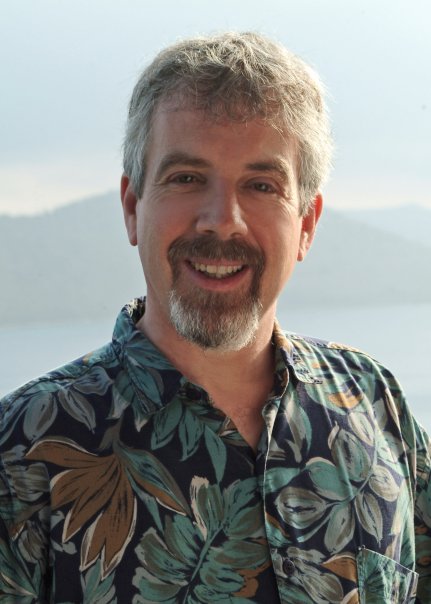 Activist C.T. Lawrence Butler is co-founder of Food Not Bombs, the international network of local organizations feeding homeless and redistributing edible food that would otherwise go to waste. Local Food Not Bombs groups operate by consensus, and C.T. has led workshops in the US, Europe and Africa, showing thousands that horizontal structure is possible. He’s the author of the definitive On Conflict and Consensus, as well as Consensus for Cities and Food Not Bombs. He has been arrested over fifty times protesting war, nuclear power and exercising his right to give away food.
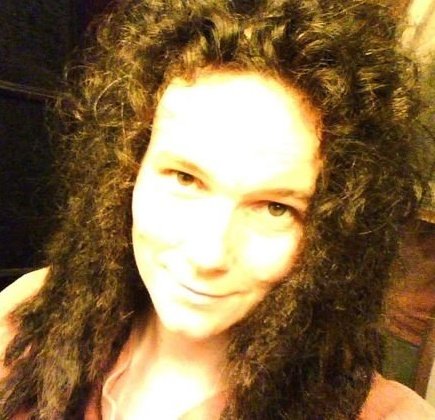 I, Wren Tuatha, am a writer/filmmaker/facilitator who has lived and practiced consensus decision-making at Heathcote Community for fifteen years. I’m Artist-in-Residence there, and am currently writing a book, Consensus for Kids, based on twenty-five years in alternative education and seven years designing and facilitating Heathcote’s Open Classroom. I am a facilitator/consultant to Intentional Communities, helping established and forming communities prioritize what I call “social technologies”—consensus, conflict resolution, ZEGG Forum, etc. My website, HippieChickDiaries.com, is a first person account of life in Intentional Community, or, as I like to put it, “Wren Tuatha’s complicated adventures in simple living….”
 IMC is a network of collectives, established in 1999 around the anti-WTO protests in Seattle. Going to Dakar, IMC will be covering the World Social Forum, a series of events in answer to the capitalist World Economic Forum. IMC organizers are committed to members learning interpersonal communication and inclusive decision-making, as well as practical media skills, such as building radios and transmitters.
To organizers, the point is really the process. “If we don’t have consensus training, then it’s just a technical workshop,” says Sphinx, a documentary filmmaker and IMC organizer from Cameroon, now living in exile in the US. Indymedia’s mission incorporates consensus principles but many of the over 200 chapters need training.
During the 2011 Convergence, over 100 Africans, as well as members from South America, the US and Europe will experience consensus, as well as Open Space Technology, and possibly ZEGG Forum, an often emotional group process in which communities and their members view and get past some blocks that may interfere with their common work. We will also facilitate cultural sensitivity work to help the diverse community come together through understanding.
Now that our organizing structure has been adopted by the group, we need funding to make the trip. We need to raise $11000 for our consensus work in Dakar.
DESCRIPTION AMOUNT
WSF reg & on ground expenses, CT & WT 1000
airfare for CT & WT 5000
CT home expenses 1500
WT home expenses 1500
100 copies of On Conflict and Consensus 1500
emergencies & miscellaneous 500
11000
I became acquainted with GEO’s Michael Johnson through several ZEGG Forum facilitator trainings at Ganas Community. And I’m excited that he and I are beginning to collaborate in helping worker-owned cooperatives continually develop their social technology skills, so that existing horizontal structures don’t have to revert to hierarchy, and so that all members can share power and be heard in decision-making. This breeds a profound sense of community, and streamlined energy to act on and realize our dreams.
IMC organizers like Sphinx want to use the consensus community at the Convergence to inspire participants to go home and create a handful of sustained, working models of consensus in Africa.
Through my site and networking, I’ve advanced my goals of putting Intentional Community on everyone’s list of “top ten ways to go green,” and helping communities, landed, work or affinity based, to realize that social technologies—the ability to make decisions that include every member’s buy-in, skills at arriving beyond conflict by listening and understanding the other, not just delivering one’s own point—are as important to a community’s success as having the greenest building idea or innovative Permaculture garden design.
An upcoming book C.T. and I are working on develops this idea. Often people tell us that they tried consensus or saw it in action somewhere and they decided that it was too slow or didn’t really work. We agree that consensus done poorly looks just like that, and it isn’t satisfying or effective. We observe that people try to apply the basic concepts of consensus but have problems if they are neglectful or unaware of what we are coming to call the body and the soul of consensus.
When I was in film school, instructors would admonish us to learn the rules first, then feel free to break them. In the same way, consensus has a specific structure, or “body,” that should be learned, not because rules are rules, but because getting them deeply will inform your choices when you go to improvise. We see well-meaning activists who are quick to shed the saddle but then don’t know how to ride the horse.
Also, horizontal structures such as consensus are true paradigm shifts, not just changing Robert’s Rules of Order for Butler’s. Over time practitioners shed old habits, assumptions and attachments and form new curiosities, learning to trust the group. But in the meantime, consensus decision-making with members who are still trying to debate or practice old styles of leadership can be hard. We think of the paradigm shift individuals and groups go through as the “soul” of consensus.
So, as you might imagine, it is hugely important to the Dakar Indy Media Convergence that the architects of the “body” be there to help community members discover the “soul” of their community’s process.
What can you or your organization contribute? We are asking for donations totaling $11,000 to fund our travel and facilitation efforts, as well as providing students with books. We plan to blog daily from the Convergence and the WSF, as connectivity allows.
If you should wish your contribution to be tax deductible, we can work through Indymedia’s finance committee, a non-profit.
Please contact Wren Tuatha, curiocoast@comcast.net, 410-458-2310 or C.T. Butler, ctbutler@together.net, 301-586-2560 for details.
Thank you so much for partnering with us in this work that can help all groups deepen the difference they’re trying to make in the world.
Wren, Heathcote Community, November 11, 2010
Open Classroom: A Great Year Closes

What an amazing year Heathcote Community’s Open Classroom had, thanks to our curious, energetic learners and my apprentice, Gloria (above, left) and Heathcote intern Kwame (above, right), both of whom practiced putting down their expectations of the kids’ academic acheivment and finding their curiosities about our students’ emotional, social and environmental lives.
 Gloria, a Heathcote Community member and resident of our strawbale house Polaris, right, is a science and math teacher who came bearing microscopes, minerals, birds’ nests and books, books, books! Now under her leadership we’re looking at expanding Open Classroom to five days a week, with many more students and interns, and an Arts and Sciences focus. Go NatureGlo!
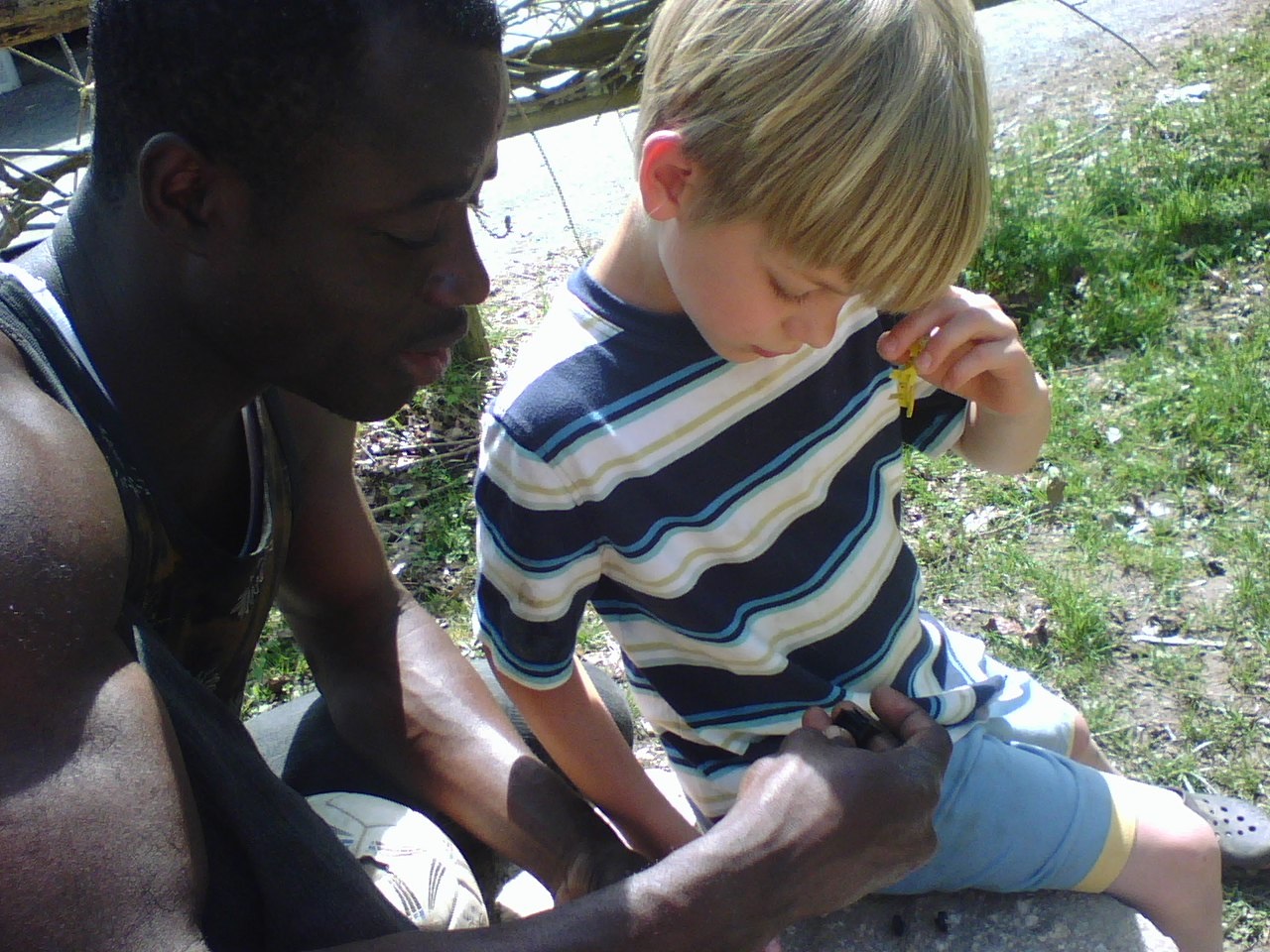 Kwame, a gardening and community life intern at Heathcote, is from Ghana. He spent many of his winter hours with us while there was less gardening to do. And of course, the kids took to him and climbed him like a tree, as they do all our twenty-something interns. He shared his family photo album and the kids mentored him in how to play in the snow during Snowmaggedon. The sight of Kwame gleefully diving into a snow bank as if it were a swimming pool will stay with me for a while!
The learners lead their facilitators into explorations of mazes, Monopoly, origami, paper airplanes, sharks, dolphins, horses, wolves, chipmunks, dragons, pandas, beavers, wombats, Singing in the Rain, STOMP, frogs, tadpoles, snakes, cooking, the food pyramid, bikes with no training wheels, ladyslipper, swinging, Frederick the Mouse and torn paper art, collage, playing store, card games, book making, chess, cheetahs, Cheetah Girl, Shark Boy, Shark Girl, Lava Girl, Lava Boy, Spiderman, Peter Parker, gymnastics, circus, juggling, unicycling, tai quan do, and so much more that is, well, life!
Open Classroom will provide children’s activities and information about the program and internship opportunities at Spoutwood Farm’s Mother Earth Harvest Fair, Sunday, October 3, 2010. Join us!